Introducing CROSSY GLOBAL, connecting employers, domestic support organizations, and overseas sending organizations through one seamless matching platform. Please feel free to contact us for more information.


Where Connections Never End

The only service in Japan connecting cross-border business expansion
Matching
Registration Support
Candidate Introduction
Background Checks for Job Seekers
News
News

A Global Workforce
Matching Platform
A business matching platform supporting the Specified Skilled Worker, Employment for Skill Development, Engineer/Specialist in Humanities/International Services categories
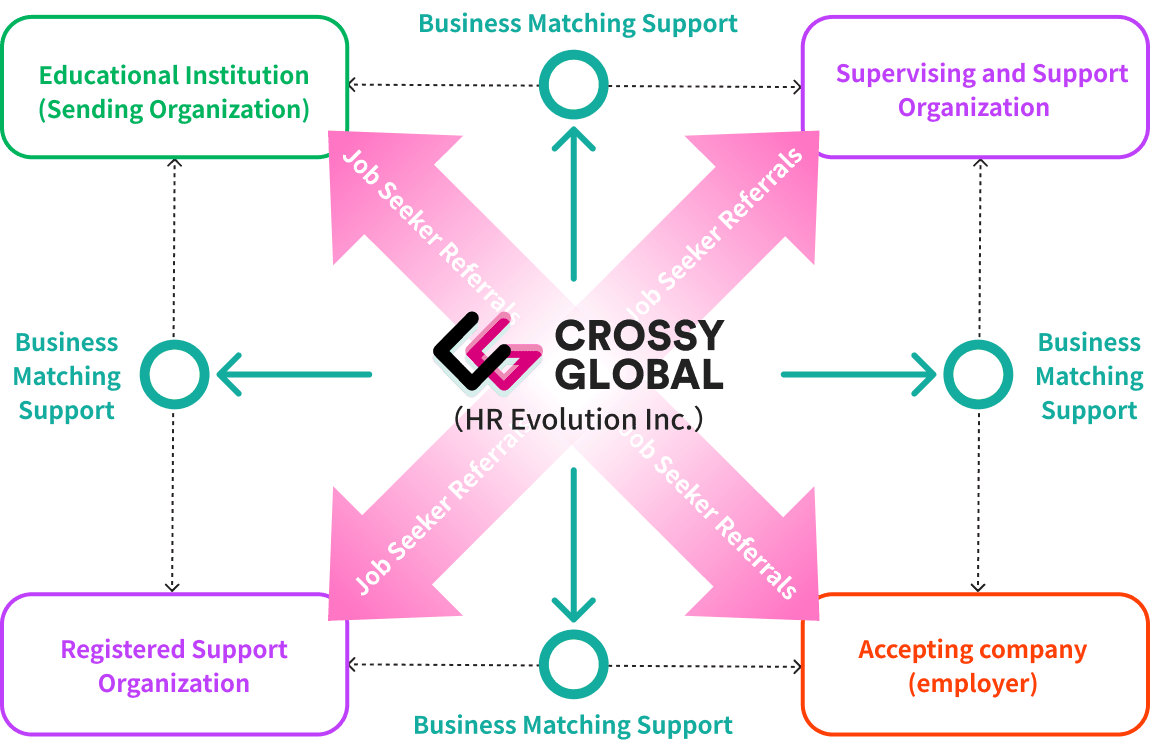
This platform is designed to connect organizations involved in the employment of foreign workers in Japan under three residence statuses: Specified Skilled Worker, Employment for Skill Development, and Engineer/Specialist in Humanities/International Services.*1 It brings together Accepting Company (employer), Registered Support Organizations (for Specified Skilled Worker), Supervising and Support Organizations (for the Employment for Skill Development Program), and Educational Institution (Sending Organization). Through this business‑matching platform, users can efficiently connect with partner organizations and be introduced to qualified foreign talent.
CROSSY GLOBAL.biz supports four languages across three countries: Japan, Indonesia, and Vietnam.*2
*1 As of June 2026, the accepting country is "Japan," and the sending countries are "Indonesia" and "Vietnam." We plan to expand the areas of both accepting and sending countries.
*2 Supports four languages: Japanese, Indonesian, Vietnamese, and English
Featured Companies by CROSSY GLOBAL.biz Team
Educational Institution (Sending Organization)
Registered Support Organization
Supervising and Support Organization
Accepting company (employer)
Featured Companies by CROSSY GLOBAL.biz Team
Educational Institution (Sending Organization)
Registered Support Organization
Supervising and Support Organization
Accepting company (employer)
Search for Educational Institutions (Sending Organization)
Country of Origin
Status of Residence
Industry / Job Type
Work Location (Country)
Examples of Listed Companies

biz (Target: Business Users) Content

Procedures and Requirements for Moving from Technical Intern Training Program (TITP) to Specified Skilled Worker (SSW)
Table of contents1. Comparison of TITP and SSW2. What Will Change Under the New “Employment for Skill Development” System3. Three Requirements to Switch from TITP to SSW4. Application Flow and Required Documents5. Benefits of Swirching and Points to Consider6. Practical Tips and Common Issues7. Summary8. References / Sources— Including the impact of the new “Employment for Skill Development” systemJapan is facing serious labor shortages, and foreign workers are now essential partners in many industries. At the same time, the rules are changing. Many companies and workers find it hard to understand the steps to move from the Technical Intern Training Program (TITP) to the Specified Skilled Worker (SSW) status, and how the new ‘Employment for Skill Development’ system will affect this pathway. This article explains the differences between the systems, the key requirements for switching, and the practical process and documents you should prepare. The goal is to help you keep employment stable and follow the rules. 1. Comparison of TITP and SSWTo switch smoothly and legally, it helps to understand the basic purpose of each program. TITP is mainly a training scheme. SSW is a work status for people who can contribute as job-ready workers. 1-1. Differences in Purpose and Basic Structure The table below summarizes the main differences between the current TITP, SSW (i), and SSW (ii) (a higher skill level). Item TITP (Current) SSW (i) SSW (ii) Main purpose Skill transfer (international contribution) Addressing labor shortages Addressing labor shortages Skill level Start from beginner level Knowledge/experience (verified) Highly skilled (leadership level) Period of stay Up to 5 years Up to 5 years total No renewal limit (possible path to permanent residence)Family accompaniment Not allowed Generally not allowed Allowed (spouse and children) Job change (transfer)Generally not allowed Possible within the same field/job category Possible within the same field/job category Japanese language proof Not required at entry (some exceptions) JLPT N4+ or JFT-Basic A2+ (field exceptions) No test proof required Support obligation Guidance by supervising organization Support by the employer or a Registered Support Organization Not required (company choice)TITP is a program designed for people to “come to learn,” whereas the Specified Skilled Worker program is premised on employment as “job-ready talent.” In addition, following the filed expansion in 2023 (1), SSW (ii) can now be accepted across a broader range of industries. As a result, companies are increasingly able to present a seamless career pathway—from the stage of “developing” talent to the stage of having them “contribute over the long term.”1-2. Background and Current Status of the Shift from TITP to SSW Currently, approximately 40% of foreign nationals residing in Japan under SSW (i) have transitioned from the TITP (2). For employers, keeping workers who already know the workplace culture, safety rules, and job terms can reduce recruitment costs and the risk of mismatch. 2. What Will Change Under the New “Employment for Skill Development” System In June 2024, Japan passed a legal revision that will abolish the current TITP and introduce a new system called ‘Employment for Skill Development’. (3)(4) This is more than a name change. The goal shifts from ‘international contribution’ to ‘securing and developing human resources’ for Japanese industry. 2-1. Differences Between “Employment for Skill Development” and TITP One key difference is that the new system is designed from the start as a pathway to SSW (i). In other words, connecting to SSW becomes a clear legal objective. This alignment helps international talent maintain career continuity and realize long-term success in an environment designed to support sustained growth.2-2. Overview and Purpose of the “Employment for Skill Development”The stated purpose is to make Japan a ‘country chosen’ by foreign workers and to secure the people needed to support Japanese industries. The design includes: Establish Supervising and Support Organization to strengthen protection of worker’s rights (to reduce abusive brokers and unclear fees). Clearer career paths: accepting companies must help workers gain the skills and Japanese ability (Equivalent to N4) needed for SSW (i) in about three years. 2-3. Moving from Employment for Skill Development to SSW (i)After completing the three-year period under Employment for Skill Development, workers can move to SSW (i) if they meet the requirements. A key difference from TITP is that, in principle, passing an exam becomes mandatory. Typical requirements include: Passing Grade 3 of the Trade Skill test or the SSW (i) Skills Evaluation Test (depending on the field). Passing JLPT N4 or higher (or an equivalent Japanese test). Note: if the worker does not pass by the end of the three years, a 6-month extension (Designated Activities) may be available to re-take the exam. 2-4. Creating a “Workplace People Choose” (What Companies Need to Provide)Under the new system, limited job changes (transfers) may be allowed if certain conditions are met—such as working for the same employer for 1–2 years and meeting set Japanese and skills standards. Companies should not treat foreign workers as fixed labor. A workplace that offers fair treatment, clear wage increases, and Japanese learning support is more likely to be chosen by workers who want to stay.
2026.07.20

Salary Ranges and Key Considerations for SSWs and Technical Intern Trainees
Table of contents1. Comparison of TITP and SSW2. Comparison of Salary Ranges and Statistics for SSWs and Technical Intern Trainees3. Essential Rules for Wage Determination and Objective Proof4. The Structure of “Total Cost” That Companies Must Understand5. Important Rules Regarding Pay Slips and Deductions6. Outlook for 2026 and Beyond: Transition to Employment for Skill Development and Restructuring of the Wage System7. Summary: Toward the Sustainable Utilization of Foreign Talent8. List of References and Sources As Japan faces a growing labor shortage, foreign talent is becoming increasingly essential. At the same time, many companies are struggling to keep up with major regulatory changes—particularly the transition from the long-standing Technical Intern Training Program (TITP) to the Specified Skilled Worker (SSW) system, as well as the introduction of the Employment for Skill Development system scheduled for 2027.Amid these changes, designing fair and compliant wage structures has become more important than ever, especially ensuring that foreign workers receive compensation equal to or higher than that of their Japanese employees.This article explains the latest salary trends, the relevant legal rules, and future wage structures considering the upcoming introduction of the Employment for Skill Development System. 1. Comparison of TITP and SSW Before designing wage structures, it is essential to understand the fundamental differences between the two systems.Differences in the Objectives and Basic Structures of Each System: From Support to WorkforceTechnical Intern Training Program (Technology Transfer)Objective: “International contribution” through skill and technology transfer to developing countriesWages are often set close to the minimum wage because the program focuses on learningSpecified Skilled Worker (Labor Force Recruitment)Objective: Directly secure labor for industries facing severe labor shortagesTargets individuals with proven skills who can contribute immediatelyWages must match market standards for Japanese employees in comparable rolesBackground of the Transition from TITP to SSW and the Current Situation as of 2026 As of 2026, it has become common for trainees with three or more years of experience to transition to SSW status (1)(2). This benefits companies by retaining trained personnel and provides foreign workers with higher wages and longer-term residency opportunities.However, in 2026, competition for talent is increasing, so it is essential to set conditions with a proper understanding of system differences, such as the freedom to change jobs. 2. Comparison of Salary Ranges and Statistics for SSWs and Technical Intern Trainees When considering salary levels for SSWs, the first reference point should be official statistical data. These workers are clearly defined as “workers,” and fair wages are required. Average Salary Levels for SSWs Based on the Latest DataAccording to the Immigration Services Agency of Japan (2024), average base salaries for SSW (i) employees typically range from 200,000 to 240,000 yen per month(2)(3).Unlike Technical Intern Trainees, SSWs are considered “immediately employable individuals with a considerable degree of knowledge or experience,” so their salary ranges are set higher than those of interns (4). Including overtime and allowances, many workers earn 250,000 to 280,000 yen, comparable to young full-time Japanese employees. Salary Structure for Technical Intern Trainees and Pay Increases When Moving to SSW In contrast, the average base salary for Technical Intern Trainees is generally around 170,000 to 190,000 yen per month. TITP was originally designed for international contribution (technology transfer), so wages were often set in line with the minimum wage. With the transition to the SSW, companies are now required to shift their mindset from treating Technical Intern Trainees as “intern-level pay” to viewing them as “worker-level pay” (4). If a company has foreign workers who wish to switch their status from the TITP to the SSW within the company, there is a risk that they will leave for other companies unless offered a pay raise of approximately 30,000 to 50,000 yen per month.[Industry -Specific Data] Highest Wages in Infrastructure and FinanceThe following table shows wages by industry, based on the Ministry of Health, Labour and Welfare’s “2024 Basic Survey on Wage Structure” (5). IndustryWages (thousand yen)Year-on-Year Change (%)Wage Characteristics Electricity/Gas/ Heat Supply/ Water Supply437.56.7Due to the demand for highly specialized technical skills, this sector ranks at the top across all industries.Finance/Insurance410.64.4High levels of specialization and profitability, coupled with demand for highly skilled IT professionals driven by digital transformation, are pushing wages upward.Construction352.60.9Chronic labor shortage. With additional allowances such as on-site premiums, even for SSWs, high wage levels are necessary.Manufacturing318.64.1Stable levels. The latest survey shows a high rate of change due to momentum for wage increases in manufacturing workplaces.Accommodation/Food Service Industries269.53.9Although this is the lowest level across all industries, the rate of increase exceeds the industry average due to labor shortages The following table shows wages by industry, based on the Ministry of Health, Labour and Welfare’s“2024 Basic Survey on Wage Structure” (5).Data shows that higher wages are common in jobs requiring specialized skills or heavy physical work, such as construction. Meanwhile, although base pay is lower in manufacturing and accommodation/food services, night shift and overtime pay help increase overall monthly income.
2026.07.20